Saturday, April 21, 2012

Bill to streamline mine permit introduced in Congress

Nevada Congressman Mark Amodei  introduced the Strategic and Critical Minerals Production Act (H.R. 4202), "aimed at streamlining the federal permitting process for mineral development" according to an interview on Mineweb.com.  He argued that the US is tied for last in the world in permitting mines due to permitting delays.  [Right, location of proposed Rosemont Copper mine south of Tucson. Opponents of the mine are carrying out a well-publicized campaign aimed at delaying the federal permitting process in hopes of making the project untenable]
The National Strategic and Critical Minerals Production Act of 2012 will require the U.S. Department of the Interior and the Department of Agriculture "to more efficiently develop domestic sources of strategic and critical minerals and mineral materials; including rare earth elements."
The measure defines strategic and critical minerals as those that are necessary for national defense and national security requirements; for the nation's energy infrastructure including pipelines, refining capacity, electrical power generation and transmission; to support domestic manufacturing, agriculture, housing, telecommunications, health care and transportation infrastructure; and for the nation's economic security and balance of trade.
The bill would  "limit the total review process for mining permits to a maximum of 30 months unless signatories agree to an extension."
Amodei said H.R. 4202 "ensures American mineral mining projects are not indefinitely delayed by frivolous lawsuits by setting reasonable time limits for litigation" including setting a 90-day  time limit to file a legal challenge to an energy project. The bill requires legal challenges to a mining project be filed in the judicial district where the project is located, and limits any preliminary injunctions to halt mining projects to 60 days unless the court finds clear reason to extend the injunction.   A subcommittee legislative hearing on the bill is scheduled for April 26.
The measure defines strategic and critical minerals as those that are necessary for national defense and national security requirements; for the nation's energy infrastructure including pipelines, refining capacity, electrical power generation and transmission; to support domestic manufacturing, agriculture, housing, telecommunications, health care and transportation infrastructure; and for the nation's economic security and balance of trade.

Friday, April 20, 2012

Uranium company merger includes Arizona mine, properties

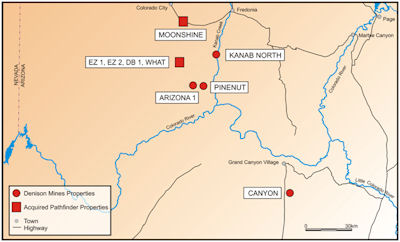
Energy Fuels Inc, is merging with Denison Mine Corp.'s US assets which include the Arizona #1 uranium mine in northern Arizona, and the White Mesa mill in Utah, which is the only operating uranium mill in the country according to news reports.  Denison has other mines in Arizona that are going through the permitting process which would be part of the merger.  The Globe and Mail reports that "Denison will receive roughly $106-million worth of Energy Fuels's stock in return for the assets. As a result, Denison will own about two-thirds of Energy Fuels following the transaction."

My sources tell me the idea of the merger only started five weeks ago.   [Right, Denison's mine, proposed mine, and other uranium prospects in norther Arizona]

Arizona Mining Advisory Council meets for first time

The Arizona Mining Advisory Council focused on organizational matters in its first meeting this week.   The Council was established by statute last year, with primary duties of 1. Reviewing mining policy in this state as established by law and as administered in all functional areas of state government, and 2. Reviewing, advising and making recommendations to state agencies on proposed rules and budget allocations affecting mining.

State Mine Inspector Joe Hart was chosen as Chair by the Council members.  The Council expects to meet every two months to begin, but long term, is likely to meet quarterly.

Is Freeport a takeover target?

Phoenix-based Freeport McMoRan Copper & Gold is being talked about as a possible takeover candidate by financial analysts.  A review on Mineweb.com quotes one hedge fund analyst as saying "Freeport has probably the most attractive assets in the world with its [Grasberg] copper mine in Indonesia."  The company had a market capitalization of $35 billion earlier this week, but a takeover price is speculated to be over $45 billion, assuming a 30% premium.

The article said "Freeport, the world's largest publicly traded copper miner, was valued at 3.3 times its earnings before interest, taxes, depreciation and amortization in 2013," which they say is about a third less than the median for large copper producers.

Possible buyers would be limited - suggestions include Rio Tinto, BHP, and Anglo-American.   

Since it's peak price in January 2011, Freeport's stock price has dropped 39% following a workers strike at the Grasberg Indonesia mine, and weakening demand for copper by China.

Thursday, April 19, 2012

Florence copper economic benefit of $2.2 billion


A study of the proposed Florence in situ copper project by the William Seidmen Research Institute at ASU projects a total economic impact of $2.245 billion, with over $1 billion of that in Pinal County. The study notes that copper workers make 44% higher salary than the state average and that 36% of the homes in the town of Florence are unoccupied. [Right, cross section of project. Credit, Curis Resources]
Conclusions in the ASU Economic Impact Study as listed in a news release from Curis Resources, include, :
* The project will create and support an annual average of 681 Arizona jobs over the duration of the three phases of development activity
* New jobs created are expected to support head-of-household wages, with an industry average of 44 percent more than other Arizona industry jobs.
* Two out of three jobs can be sourced from workers in Pinal County.
* Personal income for Pinal County residents will rise by $709 million.
* Arizona governments will collect approximately $325 million in taxes and royalties.
The report says "the Florence Copper property hosts a deposit that lies between 400 – 800 feet below the surface, with measured and indicated oxide mineral resources of 429.5 million tons grading 0.331% total copper (at a 0.05% total copper cutoff) and containing 2.84 billion pounds of copper.

Due to the presence of soluble copper oxide mineralization, extensively fractured bedrock, and groundwater conditions that allow for both copper recovery and groundwater protection, the Florence Copper Project site is considered to be highly amenable to in-situ copper recovery methods."

Sunday, April 15, 2012

Complexities of instream flow rights


There's an analysis of instream water rights issues in Arizona on the Montgomery & Associates Arizona Water Policy Update website, titled, "Why would anyone want to inhibit the development of instream flow rights in Arizona? The answer is more complex than it may seem.."

Authors Juliet McKenna, Taylor Shipman, and Michele Robertson explains that "new instream flow rights establish a standing in the watershed that can be used to oppose the severance and transfer of existing surface water rights — even if those rights are the most senior in the system. In other words, the proliferation of instream flow rights threatens the ability of existing surface water right holders to manage their rights and could potentially effectively “lock” existing rights to their current place and purpose of use indefinitely." [Photo credit, AZ DEQ]

Call for papers for Arizona Hydrological Society Annual Symposium


The Phoenix Chapter of the Arizona Hydrological Society (AHS) is soliciting abstracts for papers and posters to be presented at the AHS 25th Annual Symposium.

September 18 - 21, 2012, Desert Willow Conference Center, Phoenix, Arizona

The Annual AHS Symposium is a premier event in the southwest for hydrology and water resources science, engineering, and public policy. AHS solicits descriptions of projects and research from hydrologists, geologists, engineers, planners, water policy and legal professionals, and teachers. This year’s technical sessions will focus on the following topics focused on water and water science in Arizona and the Southwestern United States:

· Water-Energy nexus
· Drought Conditions
· Surface Water-Groundwater Interaction
· Tribal issues
· Water Reuse
· Modeling and GIS
· Water Harvesting
· Sustainability
· New Technologies
· Colorado River Issues
· Water Quality
· Water Rights and Adjudications
· Conservation
· Privatization (who owns the water?)
· Recharge
· Regulatory Issues
· Surface Water
· Water Supply and Delivery/Distribution
· Subsidence
· Climate Change
· Groundwater Remediation
· Growth
· Monitored Natural Attenuation
· Social Ecological Systems

This year’s symposium will also encourage poster submittals. Please submit your abstracts no later than June 30, 2012. Abstracts should be 250 words or less and include title, authorship, and affiliations. Please include a brief biographical sketch of the primary author(s). Contributors will be notified of abstract acceptance on or about July 15, 2012.

Abstracts can be submitted electronically to:
Summer Waters at swaters@cals.arizona.edu

Town of Florence condemns copper company offices


The rancorous debate over the proposed in situ copper recovery project in Florence took a strange turn last week when the town condemned the offices and visitor center of Curis Resources, over driveway access and water issues. I believe the photo at right is of the affected buildings. [Credit, Curis Resources]

According to the TriValley Central newspaper, the town says "Curis was first notified of the violations and the need to make the necessary improvements on July 15, 2010. The owner made no attempt to rectify the health and safety violations or to begin the process of rectifying the health and safety violations, the town said."

In a follow-up story (editorial?) by the Florence Reminder, the newspaper editor quoted Curis officials from a response to questions they posed:

“This is a highly unusual act, by any measure, and seems far beyond what would be considered reasonable or conducive to private business in Florence. Particularly given the fact that the building has been in continuous use for the last 20-plus years without incident."

“... this appears to be a deliberate act by the town to seek publicity and publicly harm Curis and attack the integrity of our employees – many of whom are residents of this community.”

Economist magazine weighs in on Arizona copper projects


This week's edition of Economist magazine examines proposed copper mines in Arizona in a story entitled, A boom too far? Why mining’s comeback fails to thrill some residents of “Copper Triangle.” Overall, the article emphasizes the views of mining opponents. [Right, controversial copper projects in Arizona, from the Economist article]

The article concludes with a quote by Green Valley pecan farmer Nan Stockholm Walden, "These foreign companies come in and buy American mines, strip the resources, then abandon the community."

The implicit endorsement of this view is surprising, given the Economist's normal editorial policy of strong support for international investment and exports.

Seismicity catalog for Arizona


The most recent attempt at putting together a comprehensive historical earthquake catalog for Arizona was done as part of a M.S. thesis by Jeff Lockridge, a graduate student at Arizona State University, in 2011. He includes a couple of links to the catalog and the primary sources:

http://gcc.asu.edu/lockridge/supplements/azeqcatalog.csv

Citations for the catalog can be downloaded from:
http://gcc.asu.edu/lockridge/supplements/azeqcatalog_refs.txt

When we used this catalog to develop some animations of earthquakes last year, we made a few additions and subtractions to the catalog. One clarification is that the original compilation of historical seismicity for Arizona was done by our predecessor agency, the Arizona Bureau of Mines and Geology, not by the Arizona Earthquake Information Center (based at NAU) as is listed in Lockridge's thesis. We also added in some of the larger earthquakes that have occurred close enough to Arizona to be felt substantially, even though they were located in Mexico, So. Calif., New Mexico, or Utah, and removed a few apparent duplicate records. [Right, Arizona seismicity, 2010-11. From the Arizona Geology online magazine]

The AEIC maintains its own catalog of Arizona earthquakes, nearly all of which should be in the Lockridge compilation: http://www.cefns.nau.edu/Orgs/aeic/eq_history.html.

Ref: Seismicity within Arizona During the Deployment of the EarthScope USArray Transportable Array, by Jeffrey Steven Lockridge, A Thesis Presented in Partial Fulfillment of the Requirements for the Degree, Master of Science, Arizona State University, June 2011

Saturday, April 14, 2012

SME president to keynote Forum on Geology of Industrial Minerals in Scottsdale

Drew Meyer, President of the Society for Mining, Metallurgy, and Exploration (SME), will be keynote speaker for the 48th Annual Forum on the Geology of Industrial Minerals, on May 2, in Scottsdale, Arizona.

AZGS is organizing and co-hosting the conference in partnership with the Arizona Geological Society, Arizona Rock Products Association, Arizona Mining Association, and AIPG Arizona Chapter.

Prior to forming Drew Meyer Consulting, 2012 SME President Drew A. Meyer was vice president, Marketing & Transportation Services, for Vulcan Materials Co., the largest construction aggregates producer in the United States and in the top five in the world. In that position, he was responsible for the marketing, market research, marketing support services, transportation sales and support services departments and economic forecasting and analysis for the Construction Materials Group.

In that role and throughout his career, Meyer has been an integral participant in the marketing, sales, strategic planning and business development functions of the company, responsible for transportation of aggregates by truck, rail and bulk- and self-unloading ocean-going ships.
During the last five years of his service with Vulcan, he and his staff focused on understanding the conditions necessary — and best methods — to improve aggregate pricing and overall construction materials profitability. He spent more than 35 years with Vulcan Materials, during which time he worked at the corporate, group and division levels domestically and in the Middle East. He is a graduate of The Pennsylvania State University with B.S. and M.S. degrees in mineral economics.

Meyer has been an active participant in serving the construction aggregates Industry through its associations. He was elected an Honorary Life Member of the National Stone, Sand & Gravel Association (NSSGA) in January 2004. Prior to its merger with NSSGA, he served in a number of leadership positions in the National Aggregates Association including treasurer and vice chairman. In 2003, Aggregate Manager magazine selected Meyer as the AGGMAN Professional of the Year for 2002.

Meyer is a Past Chairman of the Construction Materials and Aggregates Committee of SME, a recipient of the AIME Hal Williams Hardinge Award in recognition of outstanding achievement in the field of industrial minerals; a recipient of the President’s Citation for Outstanding Leadership and Service to SME (2003), a past member of the SME Board of Directors (2006-2009), past vice president of the SME Foundation (2002-2009) and currently a trustee of the SME Foundation.

In addition to SME, Meyer is a member of the American Marketing Association, the National Association of Business Economists and a member of the Advisory Board of the Minerals Information Institute. He has authored and co-authored many articles and made numerous presentations on subjects related to the aggregates industry, industrial minerals, and the extraction, processing and consumption of magnetic metals from municipal solid waste.

Over 100,000 attended AZ SciTech Festival


Over 100,000 Arizonans attended an Arizona SciTech Festival event, with over 300 people attending four events or more, according to Festival director Jeremy Babendure. In a summary wrap up emailed to participants, Jeremy said events such as Geeks Night Out, ASU Night of the Open Door, Chandler Science Spectacular and Tucson's Science in the City embraced their own definition of “celebrating science” and organized community resources and volunteers to carry out not only the vision of their particular event, but that of the greater festival as well. Getting individual groups involved in the festival at the community level allowed each event to take on a life of its own and provide more value to the community that it served."

To read more visit A Look Back at the Arizona SciTech Festival on the Festival blog page.

Gold mine for sale captures attention in Britain


A gold mine for sale north of Scottsdale is featured by the Daily Mail newspaper in the UK, but the paper warns that "this 117-acre mountain landscape with its own MINE will cost you $43million (and includes deadly snakes)." [Right, aerial view of Gold Hill mine area. Credit, SWNS via Daily Mail]

Along with claims of $170 million worth of gold in the ground, the story notes that "The development is around one mile north of the exclusive Desert Mountain, which plays home to a series of million-dollar properties and six Jack Nicklaus golf courses."

Gold mine scam alleged in La Paz County

The former Edmonton Oilers owner Peter Pocklington has been charged with securities fraud in what appears to be the Gold Nugget mine in La Paz County, Arizona. [Right, sign on I-10. Credit, goldnuggetmine.com]

The Arizona Corporation Commission named Pocklington, Crystal Piston Resources, Crystal Pistol Management, Liberty Bell Resources, and John M. McNeil.

The ACC complaint says "Between July 2010 and September 201 1, CPR Respondents raised over $4.8 million from over 100 investors." The company's newsletter reportedly further stated that “an initial investment of $10,000 at $1 per unit would pay a return between $25,000 and $40,000 per year.”

Among the complaints, ACC charges that the
(a) respondents misrepresented to offerees and investors the amount of recoverable gold available on the Arizona Mining Property.
(b) Respondents misrepresented to offerees and investors the ability to economically
recover gold from the Arizona Mining Property.
(c) MCNEIL misrepresented to the offeree that CPR was processing a thousand tons per month and that cash flow would begin within a week of their meeting, when, in fact, CPR had not submitted (nor was approved) to the BLM to process any amount of presumed ore over one thousand tons.

Financing for Florence copper project


Curis Resources announced that they have lined up $40 million in financing for their proposed in situ copper recovery project in Florence. The funds will come from RK Mine Finance Trust (“Red Kite") in exchange for Red Kite's ability to receive copper from the project. [Right, Curis Resources administration complex. Credit, Curis]

The Curis announcement described the deal:

Under the terms of the off-take agreement to be signed, Curis will supply Red Kite with 25%, or if the Extension Option is exercised, 30% of the Florence Copper Project’s copper cathode production for the life of the project, once the project reaches commercial production. The off-take agreement will be structured at market pricing.

Feasibility level optimization and design studies for Florence Copper are progressing. Phase 1 development is scheduled to be constructed beginning in Q3 of 2012, following the receipt of amended operating permits currently under review by State and Federal agencies. This project “start-up” phase will consist of an initial 24-well copper extraction field constructed to simulate full scale operations and a state-of-the-art Solvent Extraction/Electrowinning (SX/EW) facility that will produce LME grade pure copper cathode.

Emerging Workforce Trends in the U.S. Mining Industry


"The U.S. mining industry is expected to create 11,000 to 13,000 new jobs per year for the next 20 years, but it is an open question if mining companies can offset the projected exodus of skilled workers from the industry, according to a recent mining industry workforce study from the Society of Mining, Metallurgy & Exploration (SME)," according to a summary by John Egan for Industrial Info Resources. [Photo credit Resolution Copper]

He also noted that "Including contract labor, all segments of the mining industry employ about 350,000 workers today. The metals and minerals mined by those workers are the starting point in a value chain that accounts for between 10% and 14% of the U.S. gross national product (GNP), according to the study, Emerging Workforce Trends in the U.S. Mining Industry." The report can be purchased from SME.

Weiland elected head of AZ Board of Technical Registration

Erich Weiland started his second, 3-year term as the Geologist Member and is the newly-elected Chair of the Arizona Board of Technical Registration (AZBTR). AZBTR regulates 10 technical disciplines with over 35,000 individual registrants.

Erich last year joined Freeport McMoRan as Program Manager of Engineering where he is part of a 10-member team developing ways to improve processes at Freeport mines sites, including minimizing waste and reuse of waste materials.

[taken from the AIPG Arizona Section news in The Professional Geologist]

Friday, April 13, 2012

New national monument proposed in northern Arizona

As expected, a group of environmental groups are calling for creation of a 1.7 million acre national monument encompassing the lands in northern Arizona withdrawn from mineral exploration and additional areas, to be designated the Grand Canyon Watershed National Monument.

A 15-page proposal from the groups arguing for the monument is available online [right, map of proposed monument - in light green - from the proposal].

The AP news story says the driving factor of the plan is to prevent timber logging in the region. It also reports "the level of protection would depend on the language a president includes in the designation and what federal agency manages the monument, said Joe Fellar, who teaches public land law at Arizona State University's Sandra Day O'Connor College of Law. The National Park Service tends to have more strict regulations on national monuments than does the Forest Service or the BLM, he said."


http://matchbin-assets.s3.amazonaws.com/public/sites/990/assets/D9DJ_Grand_Canyon_Watershed_National_Monument_1.pdf

Thursday, April 12, 2012

Gulf of California quakes felt as far as Utah


A pair of large earthquakes hit the northern Gulf of California at mid-day sending shock waves felt in a few locations across Arizona and into southern Utah. A magnitude 6.2 event was followed by a larger magnitude 6.9 quake just minutes later. The main quake epicenter was about 360 miles south of Phoenix. [Right, epicenter marked by star. Colored areas are reports of where the quake was felt. Credit, USGS]

Historic mining towns map on Arizona Experience


We added a lot of new content on mining and mineral resources to the Arizona Experience website. Let me recommend you trying out the Historic Mining Towns live map. Mouse over each town and watch a slide show of historical photos.

The Mining Timeline goes back to the 1500s but the bulk of the info starts in the mid-1800s.

There is evidence that Arizona’s earliest known inhabitants mined turquoise, cinnabar, coal, and other minerals and pigments as early as 1000 BCE. For centuries, Native Americans used heat to melt copper and shape turquoise into jewelry and other decorations. The Tohono O'odham people mined Hematite near Ajo and Apache tribes used cinnabar (mercury sulfide, thought to come from the Dome mountain range in what is now La Paz county) to create crimson body paint.

Look at the entire timeline for an overview of Arizona’s mining history from the time of the Spanish explorers, or search the drop-down menu by topic. Click on any point for more information.

Over the years, approximately 400,000 mining claims have been filed in Arizona, and about 4,000 companies formed for mining. Minerals drew settlers and explorers, built towns, created railroads, and wowed the world with semiprecious stones. Arizona is the site of the quest for the Seven Cities of Cibola, the discoveries of Mountain Men, violent clashes between prospectors and Native American tribes, and, between miners and their bosses.